html PUBLIC "-//W3C//DTD XHTML 1.0 Transitional//EN" "http://www.w3.org/TR/xhtml1/DTD/xhtml1-transitional.dtd">

Links to pages on this site:
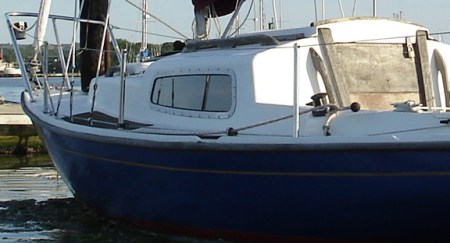
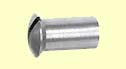
The side windows are a potential source of leaks. If the frames themselves are in good condition it is possible to renovate them. You may need to drill out the existing fastenings if they are seized - many boat windows are fastened with interscrews, obtainable from www.a2a4.co.uk

If you can't find an interscrew to fit an alternative would be a case nut, which is similar:

Both are stainless steel, interscrews are only available as A2 grade but case nuts are obtainable in the more corrosion resistant A4 grade. It is a good idea to use zinc-chromate paste when you fit them, as it prevents electrolytic corrosion occuring between the stainless and the aluminium. Zinc chromate paste (trade name Duralac) is obtainable from www.lasaero.com, and is also useful when using pop rivets on the mast and boom.
If you are fitting new seals, cut them over-length and try not to stretch them when fitting as they will shrink back. Trim them to the final length as you push the last little bit into place. Arrange for the join to be at the top of the frame. The aluminium frames themselves should be bedded in a sealant such as Sikkaflex. New seals of various sections can be obtained from www.sealsdirect.co.uk

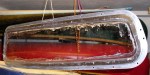
The alternative to fitting new seals is to use one of the many sealants available. Dow-Corning, Sika and 3M all produce a range of suitable marine grade sealants. The photo below is one of the side windows from Casulen II - the frame has been removed and cleaned thoroughly. The existing glass was used as a template to cut new polycarbonate windows (using a jigsaw). Thin spacers have been cut to place between the frame and window - this ensures a gap which is filled with clear marine silicon sealant. The excess is cut and removed with a razor blade when fully cured. Adrian and Jonny Moore (owners of Casulen II) have had complete success with this method, even after 1800 miles of hard sailing.

The standard hatch on a Corribee is a grp moulding. The central section is non-pigmented - not exactly transparent, even when new, and fairly opaque after a few years of exposure to the sun. It also lacks strength and is prone to jamming when it has been stepped on. Casulen II's hatch, shown below, is a Vetus Planus. Some modification of the existing opening is needed to ensure that it is bolted down to a flat surface. The flange is sealed in place with Sikaflex 291and, like the windows above, has been subjected to some very wet sailing conditions without leaking.

Links to other sites:
Yahoo message forum for
Corribees and Coromandelswww.thesimplesailor.com
Roger Taylor and Mingming -